


Electric vehicle home charger – which one should you choose?
Did you know that using an average factory Schuko charging cable can take up to ten times longer to charge your car than using a dedicated wall charger? This is not just a matter of convenience: how you handle home charging also defines your daily routine, the transparency of your electricity bill, and the safety of your home.
On the Voltie blog, we help you navigate the world of electric driving with easy-to-understand articles. In this article, we explore what an EV charger is actually good for, how it differs from a factory cable, and what criteria you should consider when choosing a home or corporate solution.
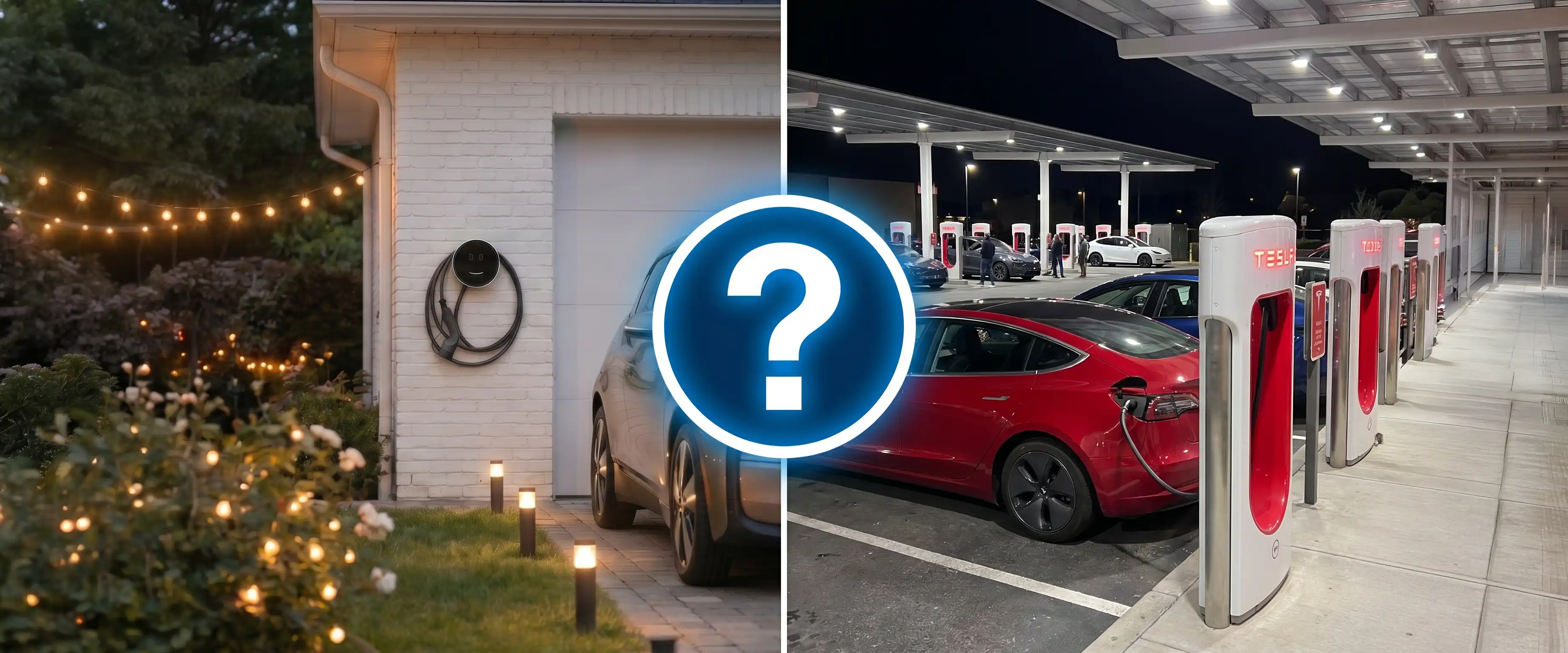
When buying a new electric car, most models come with a portable charging cable that can be plugged into a standard socket. This is an occasional lifesaver – good to have, but not ideal for everyday use.
The factory cable typically charges from a conventional grounded outlet, which subjects the household wiring to a continuous load lasting for hours. It is slow, occupies the socket for a long time, and the condition of the wall socket is critical to avoid overheating. In the long term, this is also why it is worth looking more closely at the differences between charger types.
A modern wall-mounted charger can charge at up to 22 kW in a three-phase installation, and typically at 7.4 kW on a single phase. This means that your car is guaranteed to charge overnight, and furthermore, by morning, it will be fully ready to go, not just partially.
For an average electric car with a 60 kWh battery, this means a full charge of roughly 3-5 hours during the night, compared to the 20+ hours you would have to spend with a 2.3 kW Schuko cable.

A dedicated, wall-mounted AC charger – also known as a wallbox – is a fixed-installation device designed specifically for charging electric vehicles. An electrician connects it to a separate circuit with its own fuse and protection, ensuring that other household appliances do not interfere with charging, and vice versa.
A quality EV charger does more than just supply power to the car. For example, the Voltie wallbox comes equipped with 6 mA DC leakage detection from the factory, eliminating the need for an expensive Type B RCD, and shields your home with built-in moisture, temperature, voltage, and overcurrent protection. Furthermore, Dynamic Load Management (DLM) monitors how much current is available at the main fuse and adjusts the charging power accordingly – even on a phase-by-phase basis.
The Voltie AC charger is complemented by a English-language application that makes home charging transparent. Through the app, you can check the current charging status at any time, start or stop the process, and get an accurate picture of energy consumption. The app tracks your charging habits: all key data – kWh, duration, cost estimation – is displayed clearly in one place. You can even export the statistics to a spreadsheet, compare results from different months, and get complete visibility over the process.
Additionally, if your house is equipped with solar panels, Voltie's Green and Eco modes help you charge from your own generated energy as much as possible – whether using exclusively excess solar power or supplementing it with grid power.
If you think about the difference a dedicated, wall-mounted solution makes compared to the factory charger, a few points quickly stand out:
● Predictability: plug it in at night, and the car is fully charged in the morning – no need to hunt for public chargers.
● A safer home: a dedicated circuit, built-in protections, and professional installation instead of constantly overloading a standard household outlet.
● More transparent consumption: the Voltie app shows you exactly how much you charged and when, making it easier to budget your vehicle costs.
● Future-proof solution: thanks to regular OTA updates, the charger remains up-to-date for years to come, and if you change cars or energy needs, the wallbox stays with you.
At the European level, data from the European Alternative Fuels Observatory also shows that home AC charging accounts for the vast majority of private EV owners' charging sessions – which is why it is worth choosing a high-quality, highly scalable device for the long term.
Curious to find out which Voltie wallbox charger fits your home or company car park best? Have a look around the Voltie website, or feel free to get in touch with us – we will help make home charging a natural part of your daily routine.
👉 Take a look around: