


Car battery lifespan: how to extend it consciously
Did you know that the lifespan of an electric car battery depends less on its age than on your charging habits? Every electric car owner asks the same questions: how long does a car battery last, and when does its capacity start to drop noticeably? The answer depends on several factors: usage habits, charging method and environmental conditions all affect its condition.
On the Voltie blog we regularly cover the topic of electric car batteries. In this article we look at what really determines battery lifespan, and what you can do to keep it a reliable companion for many years.
The lifespan of a car battery is the result of several factors. The three most important are charging habits, temperature and driving style.
● Charging habits: frequent full discharges and regularly charging to 100% can both speed up capacity loss. The ideal range is usually between 20 and 80 percent.
● Temperature: both extreme heat and hard frost put a strain on the system. Cars protect the battery with built-in thermal management, but parking in a garage helps a lot.
● Driving style: frequent hard acceleration and sustained high speeds wear out the battery sooner.
If you keep the battery between 20 and 80 percent, the cells are under less stress than at the extreme charge levels. Capacity then declines more slowly, and the battery keeps its range for longer. Most cars and charging apps let you set an upper charging limit, so you don't have to keep it in mind, because the system stops automatically at the level you want.

One aspect that is discussed less often is the number of charging cycles. Every charge is part of a charging cycle, but a cycle is not only a charge from 0 to 100%: two 50% charges together make one full cycle. For battery lifespan it is better to move between moderate levels than to put the battery through full cycles.
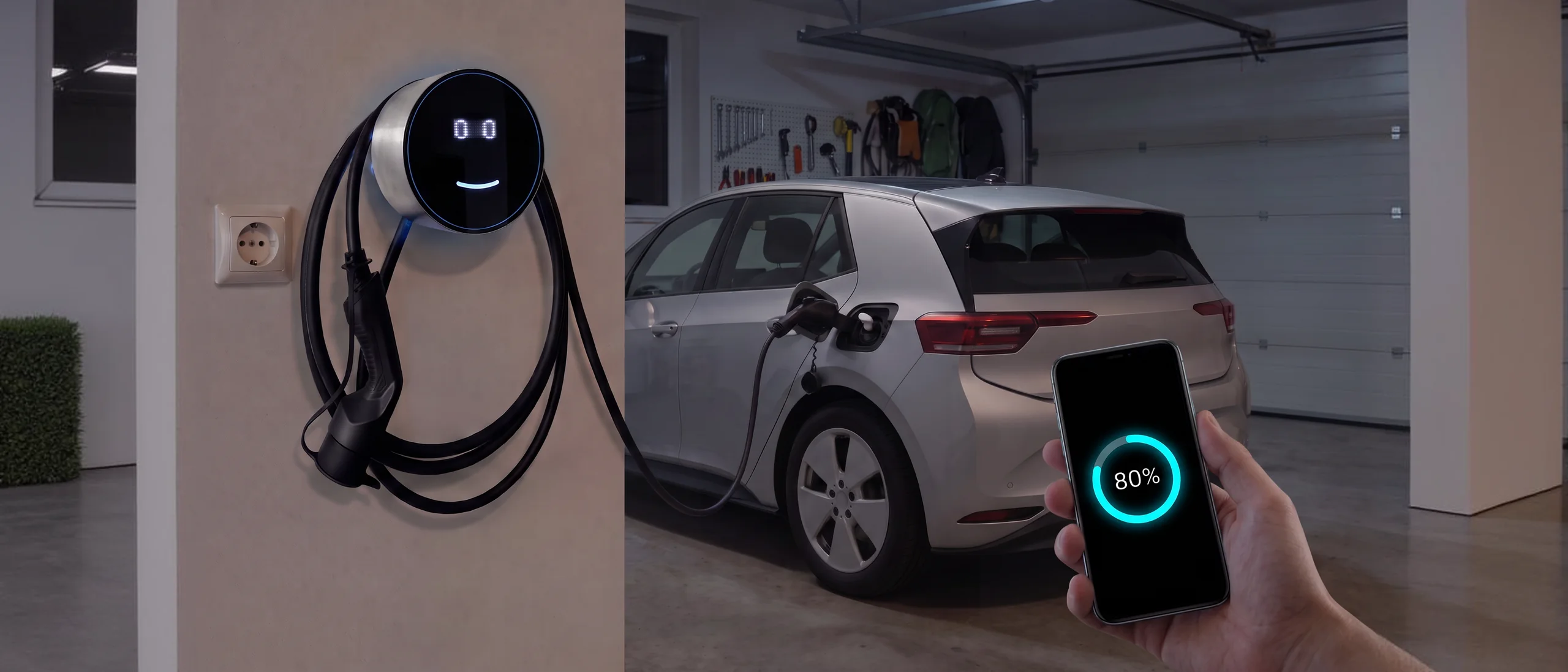
This is where home charging comes in. Slower AC charging at home is predictable and gentle: you can control both the power and the timing. Fast chargers are essential on trips, but using them often can shorten battery life. Voltie wall chargers charge at 7.4 kW on 1 phase and up to 22 kW on 3 phases, and the current can be set freely between 6 and 32 A, so in everyday use you can charge your car at a calm, gentle pace. With scheduled charging and the solar charging modes (Green and Eco) you can also decide when and from which source the system charges.
It is also important to follow software updates and the manufacturer's recommendations. The car constantly monitors the battery's condition; if you adapt to the recommended use, the lifespan can even exceed the specified value. You can check the real capacity data of individual models in independent sources, for example on EV-database.
Car battery lifespan is a technical question, and it also determines the value of the car and your everyday experience. The most important steps in short: stay within the 20-80% range, protect the battery from extreme cold and heat, prefer slow home charging, and keep up with software updates. If you avoid regularly running the battery down to zero, you have already done a lot for a long lifespan.
Conscious charging, balanced driving and the right environment together give the best result, so the battery delivers stable performance for many years. If you are looking for a home charging solution that is gentle on your battery, take a look at the Voltie website.
👉 Take a look around:


