
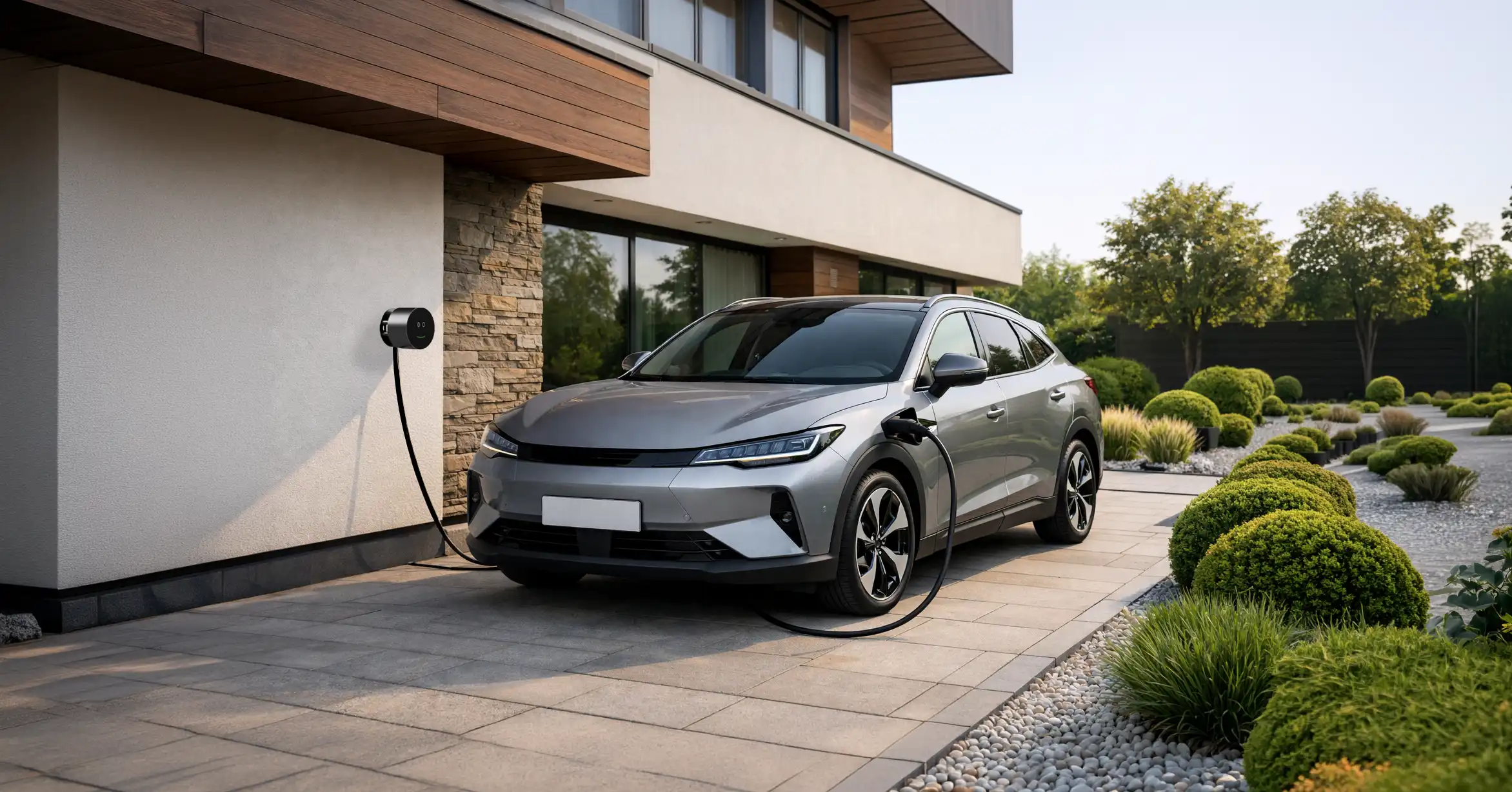
How much does 1 kWh cost at home? – Tariffs and car charging
If you drive an electric car and cover roughly 15,000 km per year, charging at home will use about 1,200–1,500 kWh of electricity for your car. With this amount of energy, the difference between the standard tariff and the two-zone night tariff can bring savings of up to 15,000–20,000 forints per year – simply depending on when you plug in the charger. So the question – how much does 1 kWh cost? – matters a great deal.
In Hungary, you currently encounter five types of tariffs in residential electricity supply: A1, A2, B, H, and B GEO. If you regularly read the Voltie blog, you have certainly come across charging tips – now we will go over what each tariff is good for, and which one you should choose if you also charge an electric car at home.
"
According to the residential base tariff, the price of 1 kWh of electricity is approximately 36–37 HUF. However, this price is subject to a condition: it applies within the government-regulated discounted consumption quota, which is 2,523 kWh per year. If you exceed this quota, the price of electricity can nearly double – which is particularly important to consider if you also charge an electric vehicle.
The exact price, therefore, depends on several factors:
which tariff you are on,
whether you consume electricity during the day or at night,
whether you stay within the annual discounted quota.
You can find details about the current official tariffs and consumer rights on the website of the MEKH (Hungarian Energy and Public Utility Regulatory Authority).

Currently, five tariffs are available in residential electricity services: A1, A2, B, H, and B GEO. Each prices electricity differently and is recommended for different purposes. Let's look at them one by one!
A1 tariff – the simple basic package
The A1 tariff is the most well-known and widespread: it offers a uniform price all day, around 36–37 HUF/kWh. It is simple, transparent, and suitable for operating any device – including an electric vehicle charger. If you do not want to be flexible with your consumption, this is the most convenient choice.
If you also own an electric car, the A1 and A2 tariffs come into consideration – these are available to you at all times. A1 stands out for its simplicity, while A2 is particularly favorable for overnight charging, if you have the opportunity to plug in the charging cable in the evening and start the morning with a full battery.
From the relevant article on Voltie's blog, you can learn in detail when, how much, and how it is worth charging at home. And on the Voltie website, you will find smart charging solutions that can even automatically schedule charging for off-peak hours – without any extra effort.
A2 tariff – saving with off-peak hours
The A2 tariff is dual-zone: electricity is more expensive during daytime peak hours and cheaper during nighttime off-peak hours. The cheaper tariff is active on weekdays from 10 PM to 6 AM (or 11 PM to 7 AM during daylight saving time). On weekends and public holidays, the lower price applies all day long.
If you can arrange to charge your car overnight – for example, with a timer – you can achieve significant savings on your monthly electricity bill with the A2 tariff. To qualify for the A2 tariff, you must receive electricity on low voltage and you need at least one electrical appliance capable of operating during off-peak hours.
Summary: calculate your electricity consumption wisely!
So, to the question – how much is the price of 1 kWh? – the answer is: it depends on which tariff you are on, when you consume, and what you use the energy for. In the basic case, you can calculate with about 36–37 HUF/kWh, but it is worth considering whether the dual-zone tariff could be a better alternative for you – especially if you also charge an electric car at home.
A kWh price only becomes a real cost once you know how much energy your car uses, so we have also explained how to calculate your electric car's power consumption.
B, H, and B GEO tariffs – for special purposes
Tariff B (also known as "night electricity") is cheaper, at around HUF 23/kWh, but is only available for 7-8 hours a day, which is also determined by the electricity provider. It can only be used for permanently wired heat storage appliances, such as electric boilers or electric heaters. It is not suitable for charging electric cars. Tariff H is designed for heat pump heating systems and is only available during the heating season. Tariff B GEO is also for heat pump systems. None of these can be used for car charging because availability is not continuous.
Tariff | Price | When is electricity available? | For car charging |
|---|---|---|---|
A1 | approx. HUF 36-37/kWh | all day | yes |
A2 | more expensive by day, cheaper during off-peak hours | all day | yes |
B ("night electricity") | approx. HUF 23/kWh | 7-8 hours a day, set by the electricity provider | no |
H | - | only in the heating season | no |
B GEO | - | not continuous | no |
Frequently asked questions
Above the discounted allowance of 2,523 kWh a year, the price can almost double. This matters especially if you also charge an electric car at home.
Would you like a quote for your charger?


